


How Nike’s latest experiment, the Nike Mind 001 and 002, reveal everything about their approach to the future of footwear
I’ve been watching Nike experiment for decades now. From my time wear-testing for Nike to building Eastbay’s first blog to employee #9 at StockX to leading content teams at places like Finish Line and Stadium Goods, I’ve seen the company throw ideas at the wall, some that stuck and changed the industry forever, others that disappeared so quietly you’d think they never existed.
The Nike Mind (including the Nike Mind 001 and Nike Mind 002) is the latest example… and it might be the most interesting one yet.
Not because of what it is, but because of what it represents about how Nike innovates when they’re not trying to sell you something.
What Actually Is the Nike Mind?
Let’s start with the basics, because even though Nike Mind products are now showing up at retailers like Dick’s Sporting Goods, Nike hasn’t exactly been shouting about this from the rooftops.
The Nike Mind is Nike’s internal venture studio – their way of building experimental products outside the traditional corporate structure. But it’s also something more specific than that. It’s the first public-facing output of Nike’s Mind Science Department, a team of neuroscientists, perception researchers, and psychologists who’ve been working on something Nike calls “sensory footwear.”
As Eric Avar, one of Nike’s most legendary designers, explained it: “Nike Mind is a new sensory footwear concept that helps reawaken the foot, the body, and the mind.”
If that name doesn’t immediately ring a bell, it should. Eric Avar has been designing some of Nike’s most innovative shoes for decades. He created the Air Huarache, arguably one of the most influential sneaker designs of the ’90s. He designed the Kobe line for years. And back in the day, he created some of my personal favorites – the Air Lambaste (which was essentially a takedown version of the Air Go LWP) and the Air Solo Flight. His fingerprints are all over Nike’s innovation history.
So when Avar talks about Nike Mind representing a paradigm shift… it’s worth paying attention.
Think of Nike Mind as Nike’s version of Google’s X division or Amazon’s Lab126, but focused specifically on what they’re calling “mental performance” rather than just physical performance. Small team. Experimental mandate. Freedom to pursue ideas that might not make immediate business sense.
Which, if you know anything about how modern Nike operates under constant Wall Street scrutiny, is kind of remarkable.

The Science Behind the Mind… Nodes, Neurons, and EEG
Here’s where it gets really interesting, and different from typical Nike innovation.
The Nike Mind products – specifically the Mind 001 slider and Mind 002 sneaker – aren’t built around cushioning technology or material innovation in the traditional sense. They’re built around neuroscience.
The bottom of each shoe features 22 individual nodes – those little orange bumps you see on the outsole. These aren’t just decorative. Each node is positioned at specific pressure points on the foot, similar to acupressure points, that Nike’s research found trigger the biggest neurological response.
But it’s not just that you can push the nodes in. They can be pushed in any direction – compressed, rotated, translated. And because there’s only a thin layer between the nodes and your foot, you can feel the texture of the surface you’re walking on through the shoe.
Concrete feels different from a running track. A running track feels different from grass. You can actually feel the blades of grass through the sole.
The Mind Science Department tested all of this extensively. They used underfoot plantar pressure sensors. They used electromyography of the lower limbs. They did EEG testing – actually measuring brain activity before, during, and after wearing the shoes.
And they found measurable differences. Changes in brain activation patterns. Changes in oscillation patterns. Neurological responses that were directly attributable to the sensory system in the shoe.
As one researcher put it: “You can’t test something like this on a robot. It’s always the athlete that’s going to give you the feedback.”
This is fundamentally different from how Nike typically approaches innovation. Usually, they start with a physical performance problem – how do we make runners faster, jumpers higher, athletes more durable – and then engineer a solution.
With Nike Mind, they started with the brain. How do we help athletes get mentally focused before performance? How do we help them recover mentally after intense activity? How do we create awareness and presence?
Mind 001 & Mind 002… The First Public Experiments
The first two products to emerge from this research were the Mind 001 and Mind 002 – minimalist slip-on shoes that look like nothing else in Nike’s current lineup.
The Mind 001 is a slider – easy on, easy off, designed for simplicity. It’s the kind of thing you’d wear in the locker room before a game, or around the house when you want to feel grounded.

The Mind 002 is a sneaker with more structure, designed for more versatile everyday use. Both feature the same 22-node system, but the Mind 002’s closed construction keeps your foot in more consistent contact with the nodes, which makes the sensory effect more pronounced.
When my co-hosts on the Sneaker History podcast and I reviewed these shoes on the show, what struck us immediately was how different they felt from typical Nike releases. Not just aesthetically, though that’s part of it. The entire approach felt different.
Tech YouTuber Mrwhosetheboss, who got early access to test the Mind products at Nike’s Oregon headquarters, described it perfectly: “It kind of feels like I have a layer of bubble wrap beneath my feet… but this isn’t just acupressure. Because your feet feel so connected to them, you can feel how they’re being pushed, which is the weirdest thing because it means while you’re wearing these shoes, you can feel the texture of the surface that you’re on.”
He found them addictive to wear, particularly the massaging feeling and how being able to feel what you’re walking on created a sense of grounding. Which makes complete sense with Nike’s stated goal – these shoes are designed to bring your attention to the present moment, similar to meditation techniques that ask you to focus on physical sensations.
The Mind products seem to have been initially released in extremely limited quantities. But now they’re showing up at mainstream retailers like Dick’s Sporting Goods, which suggests Nike is slowly expanding distribution to see how the broader market responds.
If you weren’t paying attention, you might have missed them entirely. Which, initially, seemed to be exactly the point.
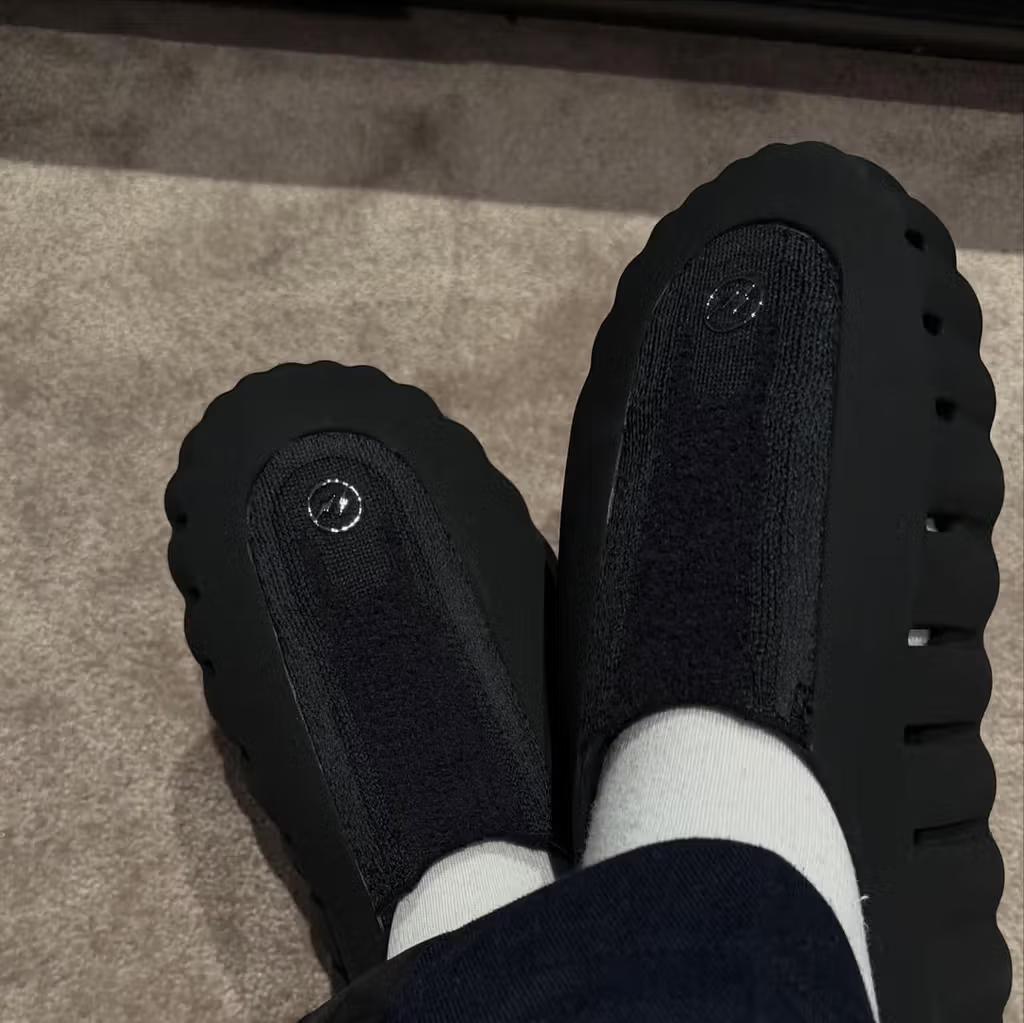
Now, people are on the lookout for fragment design collabs. Which, somehow, feels more like what we would expect.


Nike’s History of Experimental Innovation
To understand why the Nike Mind exists, you need to understand Nike’s complicated relationship with innovation.
Nike built their empire on innovation. The waffle sole. Air technology. Flyknit. React foam. Some of the most significant advances in athletic footwear came from Nike’s R&D labs. They’ve always been willing to experiment.
Eric Avar himself has been at the center of much of that innovation… from the first basketball shoe with Zoom Air through the Kobe line and the Nike Free. The Mind products are, in many ways, the continuation of thinking that started with Free.
But Avar isn’t working alone. As VP and Creative Director of Innovation, he’s leading a team that represents some of Nike’s deepest scientific talent: Chief Science Officer Matthew Nurse, Ph.D., Principal Researcher at Nike Sports Research Lab Graeme Moffat, Ph.D., and Bryan Youngs, Program Management Director of NXT (Nike Exploration Team). These are just the core leadership. Behind them is the entire Mind Science Department – neuroscientists, perception psychologists, engineers, and designers who’ve spent years developing the science and manufacturing processes that make the Mind possible.
But over the past decade, as Nike grew into a $50+ billion company, that experimental spirit got constrained by business realities. Every product launch needs to justify its existence to shareholders. Every technology needs a clear path to market. Every design needs to test well with focus groups.
The result? Nike got really good at iterating on what works, but less comfortable with truly experimental work that might not have an obvious commercial application.
I wrote about Nike’s history of unbelievable innovation in The Sneaker Newsletter, tracing how the company has always had this tension between being a massive corporation and maintaining that scrappy innovator mentality that Phil Knight and Bill Bowerman established.
The Nike Mind is, in some ways, Nike trying to recapture that original spirit by creating a space where the corporate structure can’t kill good ideas before they have a chance to develop.
The Manufacturing Challenge… Floating Nodes and Engineering Complexity
One aspect that doesn’t get enough attention is just how difficult these shoes are to make.
As the Nike engineers described it: “Being able to manufacture products where you could have floating, independent nodes on the bottom of the surface that can actually compress, rotate, and translate sensory information from the ground to the foot, has been a labor of love and a creative endeavor for the last several years.”
These aren’t injection-molded foam outsoles that can be cranked out at scale. Each node needs to move independently in multiple directions while maintaining structural integrity. The thin membrane between the nodes and your foot needs to be durable enough for repeated use while staying thin enough to transmit sensation.
This is cutting-edge manufacturing for footwear. The kind of thing that requires new tooling, new processes, and potentially new materials. It’s expensive. It’s time-consuming. It’s exactly the kind of innovation that wouldn’t survive traditional Nike product development if it needed to hit volume targets in the first year.
Which is why the Mind structure matters. By operating with different commercial expectations, the Mind team could take years perfecting the manufacturing without executives demanding to know when they’d see ROI.
The Incubation Model… Learning from Tech
What’s fascinating about the Nike Mind approach is how much it borrows from Silicon Valley’s venture studio and incubation models.
In tech, companies figured out years ago that breakthrough innovation rarely happens inside traditional corporate structures. Too many approvals. Too much risk aversion. Too many people with veto power.
So they created parallel structures – venture studios, innovation labs, incubators – that operate with different rules. Smaller teams. Faster timelines. Permission to fail. Budget that isn’t directly tied to quarterly performance.
Google’s X division gave us self-driving cars and Project Loon. Amazon’s Lab126 developed the Kindle and Echo. These weren’t products that would have survived the traditional product development process.
Nike Mind is applying that same thinking to footwear and apparel. Small team. Experimental mandate. Freedom to pursue ideas that might not make sense… yet.
The Mind Science Department itself represents this shift. As one team member noted: “Nike’s the first company to create a team like the Mind Science Department. This is a really hardcore set of neuroscientists and perception and psychology researchers.”
That’s not something you’d find in a typical footwear company’s org chart. But it’s exactly the kind of capability Nike needs if they want to explore performance beyond just physical metrics.
And well, I guess it’s not surprising considering Apple CEO Tim Cook’s recent investments in Nike.
What Makes the Mind Different from Nike’s Other Innovation Efforts
Nike’s not new to innovation labs. They’ve had the Innovation Kitchen in Oregon for decades. They’ve partnered with external design studios. They’ve acquired companies like RTFKT for digital innovation (before shutting them down, but that’s another story).
Eric Avar has been part of Nike’s innovation engine for most of his career, working on everything from the Huarache to the Kobe line to Nike Free.
So what makes the Mind different?
Autonomy: The Mind operates with significantly more independence than typical Nike projects. They’re not answering to the same approval chains.
Discipline Focus: This is the first time Nike has built an entire department around neuroscience and perception psychology rather than materials science or biomechanics.
Timeline: They’re not on the same product development cycles as mainline Nike. The Mind team spent years perfecting the node system before releasing anything publicly.
Commercial Pressure: Mind products don’t need to hit sales targets immediately. They can start limited and expand gradually based on response.
Branding: Notice how the Mind branding is distinct from Nike’s main brand identity. It’s allowed to have its own aesthetic voice, its own philosophy, its own approach to marketing.
Distribution: Mind products started with stealth drops and limited online releases, and are only now expanding to retailers like Dick’s Sporting Goods.
This independence matters because it means the Mind can explore ideas that would get killed in traditional Nike product development.
The Aesthetic Direction… Minimalism as Statement
One of the most striking things about the Mind 001 and 002 is how aggressively minimal they are.
Nike’s mainline products have become increasingly maximal over the years. Bright colors. Visible technology. Bold branding. Shoes that announce themselves from across the room.
The Mind products go the opposite direction. Muted colors. Hidden construction details. Minimal branding. They’re designed to be discovered, not to demand attention.
The innovation isn’t visible – it’s something you have to experience. You can’t see the neuroscience. You can’t see the EEG research. You can only feel the nodes working when you wear the shoes.
This feels like a direct response to where fashion and design have been moving. The “quiet luxury” trend. The popularity of brands like Jil Sander and The Row. The success of minimalist sneaker brands like Common Projects and Koio.
Nike’s recognized that there’s an audience that wants performance and quality without the visual noise. The Mind is their way of serving that audience without diluting the main Nike brand identity.
The Use Case
What’s interesting about how Nike positions the Mind products is that they’re not meant to be your basketball shoes or your running shoes.
They’re for before and after.
As the Mind Science team describes it: “Nike Mind taps into priming yourself for an activity and also recovering after an intense activity.”
Think about an athlete’s routine. Before a game, they’re trying to get focused, locked in, present. After a game, they need to decompress, recover mentally, come back to baseline.
The Mind shoes are designed for those moments. Wear them in the locker room before you play. Your feet get the sensory stimulation from the nodes. Your brain responds to that stimulation. You become more aware, more present, more focused.
Wear them after intense training. The massaging effect of the nodes helps your feet recover while the sensory input helps your mind transition out of performance mode.
As Mrwhosetheboss noted: “They’re primarily designed for athletes to wear in the changing rooms to make sure that they hit peak performance when they step onto the pitch. But I kind of like the idea of wearing them in my living room to make sure that I hit peak performance at, well, lunch.”
That’s the clever part. Nike’s positioning these for athletes, but the actual use case extends way beyond sports. Anyone who wants to feel more grounded, more present, more mentally clear could benefit from this kind of sensory footwear.
The Retail Expansion
Initially, Nike Mind 001 and 002 releases appeared and disappeared with almost no warning. Small batches through Nike.com. Maybe some whispers on sneaker Discord servers. Then gone.
But now they’re showing up at Dick’s Sporting Goods, Foot Locker, and other mainstream retailers.
This suggests Nike is moving from the experimental phase to the market validation phase. They’ve proven the technology works. They’ve refined the manufacturing. They’ve got early adopters who love the product.
Now they want to see if the broader market responds. If casual consumers, not just hardcore sneakerheads or professional athletes, find value in sensory footwear.
The retail expansion is strategic. Dick’s has the reach to put these in front of millions of people. But it’s also controlled – they’re not flooding the market, they’re carefully expanding availability while maintaining the premium positioning.
If the broader market responds positively, you can bet Nike will scale this up. If it remains niche, they can keep it as a specialized product without overproducing.

The Long Game: What Nike Learns from This
So what’s Nike getting out of the Mind, especially now that it’s expanding to retail?
Market Intelligence: Understanding whether sensory footwear resonates with consumers beyond early adopters. Do people care about mental performance as much as physical performance?
Manufacturing Capability: Building expertise in complex node-based construction that could eventually apply to performance footwear. Imagine basketball shoes with nodes that help with proprioception and court feel.
Neuroscience Platform: Establishing Nike as serious about brain science, not just biomechanics. This opens up entirely new research directions.
Brand Positioning: Showing that Nike can be more than just swooshes and athlete endorsements. They can do thoughtful, science-backed, sophisticated innovation.
Talent Development: Attracting neuroscientists and perception researchers who might not otherwise consider working for a footwear company. The Mind Science Department is a recruiting tool as much as an innovation engine.
Future Pipeline: Any Mind innovation that resonates strongly could be scaled up and integrated into Nike’s main offering.
Think of it as Nike’s R&D budget, but for brain-body connection rather than just cushioning systems.
Where This Could Go: Future Possibilities
If the Mind continues to develop and the retail expansion succeeds, here are some directions I could see it taking:
Performance Integration: Imagine running shoes with sensory nodes that improve proprioception and ground feel. Basketball shoes that enhance court awareness. Training shoes that help with balance and stability through neurological feedback.
Apparel Expansion: The Mind has focused on footwear so far, but the model would work brilliantly for sensory apparel. Clothing with nodes or textures that provide neurological benefits during warm-up or recovery.
Customization: Using EEG data to customize node placement for individual foot maps. Your brain might respond differently to stimulation than mine – why not personalize the sensory system?
Digital Integration: An app that guides you through pre-performance routines while wearing Mind shoes. Meditation integration. Biometric feedback showing how your brain responds to the sensory input.
Medical Applications: Sensory footwear for neurological rehabilitation. Diabetic foot care. Proprioception training for injured athletes.
Wellness Market: Moving beyond athletics entirely into the broader wellness space. Stress reduction. Mindfulness. Mental health applications.
The potential is significant if Nike commits to it long-term.
The Risk… Corporate Antibodies
The thing I worry about most, having seen Nike operate from the inside at various companies…
Large corporations have what you might call “corporate antibodies” – institutional forces that kill anything that doesn’t fit the established pattern.
The Mind works because it’s been given freedom to operate differently. But that freedom exists at the pleasure of Nike leadership. If the executives who championed it leave, or if there’s a restructuring (and Nike loves restructuring), or if someone decides the Mind isn’t justifying its budget…
It could disappear as quietly as it appeared.
Nike has a history of starting interesting experimental projects and then shutting them down when they don’t produce immediate commercial results. RTFKT. Various innovation labs. Collaborations that got one release and then vanished.
For the Mind to succeed long-term, Nike needs to resist the urge to either:
- Scale it too quickly (killing what makes it special)
- Demand immediate commercial justification (killing the experimentation)
- Absorb it back into the main brand (killing the independence)
The retail expansion to Dick’s Sporting Goods is encouraging – it suggests Nike believes in the product enough to give it broader distribution. But it’s also the danger point. This is where the corporate antibodies typically activate. “Why isn’t this selling like Air Force 1s?” “Why are we investing in neuroscience research for a niche product?” “Can’t we just make regular shoes with bumpy outsoles and save the R&D costs?”
What This Means for Sneaker Culture
From a culture perspective, the Nike Mind represents something sneaker culture desperately needs: innovation that’s about genuine performance enhancement, not just hype creation.
So much of sneaker culture has become about manufactured scarcity, artificial hype, and resale speculation. Limited releases of the same silhouettes in different colors. Drops engineered to create FOMO. Products designed more for Instagram than for feet.
The Mind products are genuinely experimental. They’re not leaning on retro culture, leveraging celebrity endorsements, or feeding resale speculation… at least not yet.
They’re just… different things. Built on actual research. Made well. Released with purpose.
If more brands adopted this approach – creating space for real experimentation backed by science – sneaker culture might become more interesting again.
Why I’m Critical of Nike… And Why the Mind Matters
Look, I’ve been pretty critical of Nike over the years. You’ve probably read my pieces about the Total 90 trademark disaster, the Cade Cunningham signature shoe concerns, the John Donahoe era missteps.
But here’s the thing… I’m critical because Nike is the best at this thing we love called sneakers. When you’re the industry leader, when you’ve set the standard for innovation and cultural impact, when you have the resources and talent that Nike has… the bar should be higher.
That’s why it’s so frustrating when they make preventable mistakes. That’s why the constant restructuring and layoffs matter. That’s why losing institutional knowledge hurts the entire industry, not just Nike.
But the Nike Mind? The Nike Mind has me more than curious about the future of the brand.
Imagine if Nike Mind evolves like Air did. Air started as an experiment – visible cushioning in the heel of a running shoe. Frank Rudy pitched it to Nike in 1977. The Tailwind came out in 1978. Then Nike spent the next decade figuring out how to make it work reliably, how to make it visible, how to make it matter.
By the time the Air Max 1 dropped in 1987 with the visible Air unit, Air had become Nike’s foundation. Not just a product feature – an entire innovation platform that would define the company for decades.
Now it’s the foundation of Nike’s entire basketball and lifestyle business. Decades of iteration. Billions in revenue. Cultural impact that transcends sports.
What if the Mind becomes Nike’s next “Air”? Not as a cushioning system, but as an approach to innovation itself.
What if the Mind becomes the standard for how Nike thinks about performance – not just physical metrics, but mental ones. Not just making athletes faster and stronger, but sharper and more focused. Not just engineering shoes for feet, but engineering shoes for brains.
What if twenty years from now, we look back on the Mind 001 the way we now look back on the Air Tailwind – not as the finished product, but as the beginning of something that changed everything.
That possibility exists. Eric Avar and the Mind Science Department have done the foundational work. The manufacturing is figured out. The neuroscience is validated. The retail expansion is happening.
Now it’s just a question of whether Nike protects this long enough for it to matter.
And based on what I’ve seen so far from the Mind products, based on how they’re structuring the program, based on the seriousness with which they’re approaching the neuroscience… it’s possible.
Which is why I’m paying attention. Why I’m writing about it. Why I’m hopeful despite my criticisms of Nike’s recent decisions.
Because if there’s one company that has the resources, the talent, and the legacy to build something truly innovative… it’s Nike. They just need to give themselves permission to do it without Wall Street breathing down their necks.
The Mind is that permission. Now we’ll see if they protect it long enough for it to evolve into something bigger.
My Take: Why I’m Watching Closely
After two decades in this industry, I’ve learned to pay attention when a major brand does something that doesn’t make obvious commercial sense.
Those are often the most revealing moments.
The Nike Mind 001 and Nike Mind 002 do not need to exist. Nike could keep making Jordan retros and Air Max variants forever and print money. They don’t need a venture studio for experimental footwear. They don’t need a Mind Science Department full of neuroscientists.
But they’re doing it anyway. Which suggests someone inside Nike recognizes that the company needs to maintain capability in experimental design, even if there’s no immediate payoff.
That’s encouraging.
It suggests that despite all the corporate pressure, despite the quarterly earnings calls, despite the Wall Street expectations… there’s still space at Nike for the kind of thinking that built the company in the first place.
The scrappy experimentation. The willingness to try things that might not work. The belief that innovation requires freedom to fail. The kind of thinking that Eric Avar has represented throughout his career at Nike.
Whether the Mind survives long-term depends on whether Nike can protect that space from corporate antibodies. Based on Nike’s recent history of restructuring and cost-cutting, I’m cautiously optimistic but not certain.
But for now, while it exists and is expanding to retailers, the Nike Mind is one of the most interesting things happening in footwear.
Not because the products are revolutionary (they’re innovative, but we don’t know yet if they’re world-changing).
But because the approach is. And in an industry that’s become increasingly predictable, approaches matter.
Where to Experience the Mind
If you’re curious about Nike Mind products, you now have more options than you did a few months ago:
Nike.com: Mind releases happen through Nike’s main site. Still the most consistent place to find them.
Dick’s Sporting Goods: The Mind products are now available at Dick’s, which suggests a significant expansion from the original limited drops. Check their website or visit stores.
Select Nike Stores: Some Mind products get physical releases in specific Nike retail locations.
Sneaker History Podcast: We reviewed the Nike Mind 001 and 002 in this episode, if you want to hear detailed thoughts on the actual product experience.
The scarcity is less extreme than it was, but these still aren’t everywhere. Nike’s being strategic about distribution, expanding gradually rather than flooding the market.
The Bigger Picture: Innovation in Public
What I find most interesting about the Nike Mind is that it represents a different approach to innovation – innovation in public, but thoughtfully.
Most companies do innovation behind closed doors, only showing finished products. Or they hype everything as “revolutionary” even when it’s iterative.
The Mind is Nike saying: “We’re experimenting with neuroscience and sensory footwear. We’ve done the research. We’ve built the products. Now we want to see if people respond to this.”
That honesty is refreshing.
It also creates a different relationship between brand and consumer. Instead of Nike telling you this will change your life, they’re showing you the research, explaining the thinking, and letting you decide if sensory footwear matters to you.
That’s a more mature, confident approach to innovation than the hype-driven model that dominates sneaker culture.
As one of the Mind Science team members put it: “I believe this is a new frontier and a new paradigm of performance. We’re just scratching the surface. I can’t predict what that will look or feel like, but I’m really excited to go there and start thinking about how we reshape the future of what it means to be an athlete.”
That kind of thinking – exploratory, humble, genuinely curious about where this could lead – is what great innovation looks like.
Final Thoughts: Watch This Space
I don’t know if the Nike Mind will still exist in five years. Corporate priorities shift. Leaders change. Budgets get cut. Eric Avar won’t be at Nike forever.
But right now, while it exists and is expanding, it’s worth paying attention to.
Not because every Mind product will be something you want to buy.
But because it reveals something important about how Nike thinks about its future when they’re allowed to think beyond quarterly earnings.
And that future looks more interesting than a lot of what Nike’s been doing in the mainstream.
The Mind products I’ve seen and tested so far aren’t perfect. But they’re trying to be something different, which in today’s sneaker landscape, is rare enough to be valuable.
So yeah, I’m watching. I’m curious what comes next. And I’m hoping Nike gives the Mind enough space and time to develop into whatever it’s supposed to become.
Because the footwear industry needs more companies willing to experiment with neuroscience and perception. We need more designers like Eric Avar who are willing to spend years perfecting something before releasing it. We need more departments like the Mind Science team who are asking fundamentally different questions about performance.
We’ve got enough Jordan 1 colorways. We don’t have enough genuine experimentation backed by actual research.
The Nike Mind, for now, is trying to fix that balance.
And if it evolves the way I think it could? If it becomes Nike’s next foundational innovation the way Air did?
Then we’ll look back on these first Mind releases the same way we look back on the Air Tailwind from 1978 – not as the finished product, but as the beginning of something that changed everything. Remember, back then Air cushioning was unbelievable to most.
The nodes might be the new Air units. The neuroscience might be the new biomechanics. The Mind Science Department might be the new Innovation Kitchen.
Or it might not. Innovation is hard to predict.
But for the first time in a while, Nike’s doing something that makes me genuinely curious about where they’re headed.
And in an industry that’s felt increasingly stagnant, curiosity matters.
Discover more from Sneaker History - Sneakers, Sneaker Culture, & Footwear Industry News By Sneakerheads
Subscribe to get the latest posts sent to your email.


