How a NASA engineer’s rejected idea became the foundation of a billion-dollar empire
Throughout the course of its history, Nike has celebrated the accomplishments of its signature athletes all over its Beaverton, Oregon campus with buildings, statues, and street names. Walk through the sprawling headquarters and you’ll find tributes to Michael Jordan, LeBron James, Serena Williams, and countless other athletes who’ve worn the Swoosh.
But if you’re looking for the names of Nike’s greatest contributors… the people who fundamentally changed what the company could become… you need to look beyond the athletes. The list would read like a “Who’s Who” of innovation and vision:
Bill Bowerman
Phil Knight
Steve Prefontaine
Michael Jordan
Tinker Hatfield
Marion Franklin Rudy
Marion Franklin Rudy? Who?
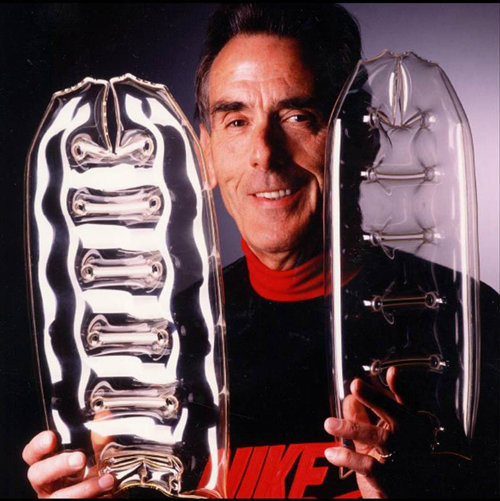
Why would Nike consider a NASA-employed aerospace engineer one of its greatest contributors? Because without Frank Rudy, there would be no Nike Air. No Air Jordan. No Air Max. No visible windows. No multi-billion dollar technology platform that defines the brand’s identity.

The Man Who Brought Space Technology to Earth
Frank Rudy wasn’t a runner. He wasn’t a shoe designer. He wasn’t even a sneakerhead. He was an aerospace engineer working on cutting-edge projects for NASA, dealing with problems that most people couldn’t even comprehend. His work involved rubber molding processes, gas encapsulation systems, and understanding how materials behave under extreme conditions.
But Rudy had an insight that would change everything.
The work he was doing for NASA… encapsulating dense gases into rubber membranes, creating pressurized systems that could withstand incredible stress… could be applied to something much more mundane. Something millions of people used every single day.
Shoes.
The concept was elegantly simple. If you could encapsulate gas into a durable rubber membrane and create an “air bag,” you could place that inside a shoe’s midsole. The hollowed-out midsole would house the air bag, which would compress under pressure and immediately return to its original shape. The result? Each step would feel lighter. Each impact would be cushioned. The repetitive stress on joints, knees, and backs would be exponentially reduced.
It was brilliant engineering applied to everyday life. The footwear technology would exponentially decrease the impact a single step has on the body. For runners logging hundreds of miles per year, this wasn’t just comfort… it was injury prevention. It was career extension. It was revolutionary.
In theory, anyway.
In practice, it was something 23 shoe companies thought was impossible.
The 23 Rejections Nobody Talks About
In 1977, Frank Rudy began his journey to revolutionize footwear. He had working prototypes. He had data from testing. He had genuine confidence that this technology would work. All he needed was a shoe company willing to take a chance.
He visited 23 of them before finding one that would say yes.
Twenty-three companies looked at his air cushioning concept and said no. The reasons varied, but they all boiled down to the same skepticism… it was a gimmick. Air bags in shoes would pop under pressure. They’d leak gas over time. They couldn’t possibly hold up under the constant stress of running mile after mile. And even if they somehow did work, who would pay a premium for invisible technology you couldn’t see or touch?
Think about that for a moment. Twenty-three separate opportunities for Frank Rudy to give up. Twenty-three times being told his idea wasn’t practical. Twenty-three rejections from companies that specialized in exactly the product category he was trying to innovate within.
The rejections must have been brutal. Here was a NASA engineer with a genuinely innovative idea, backed by scientific principles and working prototypes, being told by company after company that he didn’t understand the shoe business. That his idea wasn’t practical. That it would never work in the real world.
Most people would have quit after five rejections. Maybe ten if they were particularly persistent. But Rudy kept going. Twenty-three rejections, and he kept going.
Then he got to company number 24, in Beaverton, Oregon.
When Phil Knight Tested the Prototype
Phil Knight and Bill Bowerman were skeptical, too. And honestly, why wouldn’t they be? Blue Ribbon Sports had only recently become Nike. They were a young company trying to compete against adidas and PUMA, established giants with decades of credibility and unlimited resources. Taking a risk on unproven technology from an aerospace engineer with zero footwear experience seemed like exactly the kind of move that could destroy everything they’d built.
The smart play was to say no. To stick with what was working. To not gamble the company’s future on air bags in shoes from some NASA guy.
But Nike had something the other 23 companies didn’t… a culture of actually testing ideas rather than just dismissing them.
Bowerman had spent years in his garage, tinkering with waffle irons and rubber compounds, literally melting shoes in his quest for better traction. He understood that innovation required experimentation, failure, and persistence. Knight had been a runner himself. He knew what performance felt like at a visceral level.
So when Frank Rudy showed up with his prototypes, they didn’t just look at them and theorize. Phil Knight put them on and went for a run.
And he felt the difference immediately.
The cushioning wasn’t just softer… it was responsive in a way traditional foam never could be. It didn’t bottom out under weight. It didn’t feel mushy or unstable. The air units compressed under pressure and bounced back instantly, providing a ride unlike anything Knight had experienced. This wasn’t a gimmick. This was the future of footwear.
Nike signed Frank Rudy. And then the real work began.
A Year of Trial and Error
From 1977 to 1978, Nike’s team worked with Rudy to solve all the problems that had caused 23 other companies to walk away. The air units leaked. The rubber membranes degraded under repeated stress. The manufacturing process was wildly inconsistent. Some prototypes worked beautifully. Others failed catastrophically during testing.
Every solution created new problems. When they fixed the leaking, the ride became too stiff for runners. When they fixed the stiffness, the durability suffered. When they improved durability, manufacturing costs skyrocketed to unsustainable levels. It was a constant cycle of iteration, testing, failure, and refinement.
But Rudy’s aerospace engineering background proved invaluable. The principles he’d used for NASA applications… understanding gas behavior under pressure, rubber compound formulation, membrane integrity testing… translated directly to footwear innovation. He wasn’t guessing. He was applying genuine scientific methodology to a problem that had never been properly solved.
The engineering challenge was more complex than it seemed on the surface. The air unit had to be durable enough to withstand thousands of impacts without leaking or losing pressure. The surrounding rubber membrane had to be flexible enough to compress under weight but strong enough to maintain its integrity over months and years of use. The gas inside had to be pressurized at exactly the right level… too much and the ride would be unstable and harsh, too little and the cushioning would bottom out and provide no benefit.
They developed specialized rubber molding processes that had never been used in footwear before. They created hollowed-out midsoles precisely engineered to house the air bags without compromising structural integrity. They tested different gas compositions to find the perfect balance of compression, responsiveness, and stability. They ran stress tests that simulated thousands of miles of running.
After much trial and error, research and development, Nike finally had a working product. In 1978, they were ready for the world to see what Frank Rudy had created.
The Nike Air Tailwind Changes Everything
The Nike Air Tailwind debuted at the 1978 Honolulu Marathon in a limited release. It featured a nylon upper with suede overlays on the toe cap and heel, and a revolutionary midsole with pressurized air running from heel to toe.
The limited release at Honolulu wasn’t just a marketing play… it was Nike’s way of testing the technology in real-world conditions before committing to a full worldwide launch. They needed to know if the shoes would actually hold up. If runners would feel the difference. If Rudy’s innovation would work not just in a lab, but on the roads, in the heat, over marathon distances.
They did. The runners who wore them at Honolulu consistently reported less fatigue, better cushioning, and improved comfort over distance. The technology worked exactly as Rudy had promised.
The following year, in 1979, Nike released the Air Tailwind worldwide. And that same year, Frank Rudy successfully patented his air cushioning design.

The Patent That Changed the Game
U.S. Patent No. 4,183,156, granted to Marion Franklin Rudy in 1980 (filed in 1979), specifically detailed “a cushioning device for articles of footwear having polyurethane sacs filled with pressurized inert gas.”
That patent wasn’t just legal protection. It was Nike’s competitive moat for years to come.
While other companies could develop their own cushioning technologies, Rudy’s patent gave Nike exclusive rights to this specific approach of using pressurized gas-filled membranes for footwear cushioning. It allowed them to refine the technology, scale production, establish Air as their signature innovation, and build an entire brand identity around it before anyone else could catch up.
The timing was perfect. The running boom of the late 1970s and early 1980s created a massive audience of serious runners who cared deeply about performance and were willing to pay premium prices for innovation that actually worked. These weren’t casual joggers… they were dedicated athletes who understood that the right shoe could make them faster, more comfortable, and less prone to career-ending injuries.
The Air Tailwind delivered on all three fronts. And it was just the beginning.
From Hidden Innovation to Cultural Icon
The original Air Tailwind never became a mainstream cultural phenomenon. It sold well among performance runners, but it remained a specialized product appreciated mainly by serious athletes who could feel the difference. The air unit was completely hidden inside the midsole, invisible to anyone looking at the shoe. You had to trust that it was there, working with every stride.
That invisibility was both the technology’s strength and its limitation. The shoes performed beautifully, but Nike struggled to communicate visually what made them special. How do you convince skeptical consumers to pay a premium for technology they can’t see?
The answer came in 1982 with the Air Force 1, bringing Air cushioning to basketball. Then in 1985 with the Air Jordan 1, making Air technology part of the most significant athlete endorsement deal in history.
But the real breakthrough came in 1987 when designer Tinker Hatfield created the Air Max 1. Inspired by the exposed structural elements of the Centre Pompidou in Paris, Hatfield made the Air unit visible through a window in the midsole. Suddenly, Nike’s most important innovation wasn’t hidden anymore… it was unmistakable.
That visible Air window transformed Nike’s technology from a hidden performance feature into a design signature that defined the brand’s identity. Every Air Max since then, every visible Air unit you see on the streets today, exists because Hatfield figured out how to make Rudy’s innovation undeniable to the eye, not just the foot.
But none of that would have been possible without Frank Rudy’s initial breakthrough. The visible Air that became Nike’s identity started with the invisible Air that Frank Rudy convinced Phil Knight to believe in.

The Legacy of a Man Who Changed an Industry
Marion Franklin Rudy passed away on December 12, 2009, at the age of 90. Shortly before his death, he gave one of his last interviews about the technology he’d created. Watching the footage now, you see a humble man who understood the magnitude of what he’d accomplished but never sought the spotlight the way athletes or designers did.
By the time of his death, his invention had become so fundamental to Nike’s identity that it was genuinely hard to imagine the company without it. Every Air Jordan. Every Air Max. Every Air Force 1. Every visible Air unit, every pressurized gas chamber, every innovation that carries the “Air” name… they all trace back to Frank Rudy’s idea and his refusal to give up after 23 rejections.
His technology single-handedly changed an entire industry in all areas of performance footwear. Not just running shoes, but basketball, training, casual wear, and lifestyle footwear. Air became the standard against which all other cushioning systems were measured.
Think about how close we came to never having Nike Air. If Rudy had stopped at 22 rejections instead of 23. If Phil Knight hadn’t actually tested the prototype himself. If Nike had played it safe and said no like everyone else. If the engineering challenges had proven insurmountable.
The entire landscape of footwear would be different. Nike might not be Nike. The Swoosh might not be synonymous with innovation. The company might still be fighting for survival against adidas and PUMA instead of dominating the industry.
What Frank Rudy Taught Nike
Frank Rudy’s contribution to Nike wasn’t just the Air technology itself. It was the lesson embedded in his journey to get there.
He taught Nike that sometimes the most revolutionary ideas come from the most unexpected places. That innovation requires believing in things before they’re proven to a skeptical world. That failure is just part of the process of getting to breakthrough success. That testing ideas is more valuable than theorizing about why they won’t work.
Nike learned from Rudy that breakthrough technology often seems like a gimmick until it isn’t. That persistence matters when you genuinely believe in your innovation. That one person willing to actually test an idea is worth more than twenty-three people willing to dismiss it based on assumptions.
Those lessons shaped how Nike approaches innovation to this day. When Nike invests in new cushioning systems, performance technologies, or seemingly impossible innovations, they’re remembering the lesson Frank Rudy taught them. When they partner with engineers, scientists, and inventors from outside the footwear industry, they’re honoring his legacy.
Twenty-three companies said no before Nike said yes. And that one, yes, changed everything.
Honoring the Father of Nike Air
In 2016, Frank Rudy’s daughter donated $1.9 million to Case Western Reserve University to support the athletic program, honoring her father’s belief in innovation and athletics. The money funded new uniforms and equipment for the school’s athletic teams… a fitting tribute to a man who revolutionized athletic footwear and changed how millions of people experience sport.
On January 24th, we remember Marion Franklin Rudy, who would have turned 96 in 2026. Thank you, M. Frank Rudy. Thank you for refusing to give up after 23 rejections. Thank you for finding the one company willing to test your impossible idea. Thank you for bringing NASA technology to our everyday lives. Thank you for making our steps lighter, our runs more comfortable, and our sneakers better.
The Swoosh on our shoes carries your legacy with every step we take.
Related Reading:
- The Nike Air Tailwind: The Shoe That Changed Everything – Full history of the first Nike Air shoe
- Nike Air Technology Timeline – Explore 45+ years of Air innovation
- Shop Nike Air Sneakers
What’s your favorite Nike Air technology or shoe? Share your thoughts with us and join the conversation in our Substack community.
Discover more from Sneaker History - Sneakers, Sneaker Culture, & Footwear Industry News By Sneakerheads
Subscribe to get the latest posts sent to your email.


This technology single-handedly changed the industry in all areas of performance footwear. Specially I feel how important for Plantar Fasciitis. Though I found some important guideline from Bball Solutions https://bballsolutions.com/best-basketball-shoes-for-plantar-fasciitis/.