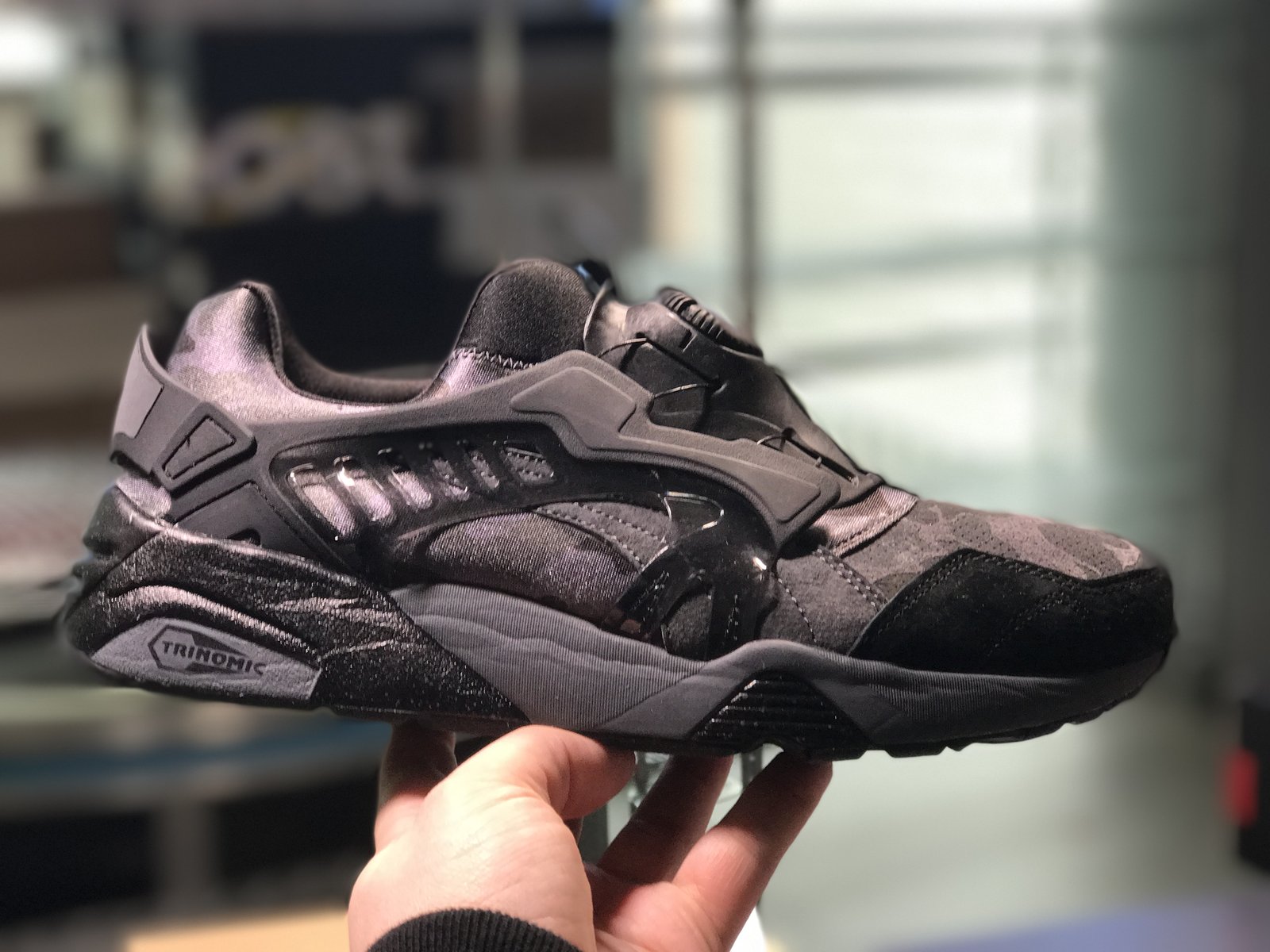
Look at almost any serious piece of performance footwear right now and you will find a dial on it. Snowboard boots, cycling shoes, football cleats, hiking boots, even running shoes, all of them quietly tightened by a little wheel you turn instead of a lace you tie. That dial has a name, BOA, and it is everywhere. It also has a grandparent that almost nobody credits. In 1991, PUMA tried to kill the shoelace, and for a few strange and brilliant years, it nearly did.
The PUMA Disc System was the brand’s first laceless sports shoe, and it was not a gimmick bolted onto a normal sneaker. It was a whole rethink of how a shoe holds a foot. Where the laces should have been sat a disc, a small geared dial, and inside the upper ran a system of wires connected to that dial. You turned the disc, it clicked, the wires drew the shoe snug around your foot, and you were locked in. A closure unit on top, a stabilizing cradle on the sides, the entire thing engineered to do what a century of laces did, except faster and with one hand.
Two years later, in 1993, PUMA gave it the form everybody now recognizes. The Disc Blaze took that laceless disc and married it to Trinomic, the hexagonal cushioning PUMA had been building into its running line, and the result was a shoe that looked like the future arriving slightly ahead of schedule. The technology spread into basketball, into the Disc System Weapon, into a whole run of products betting that the lace was a problem worth solving.
Here is the uncomfortable part, and it is a pattern with PUMA. The idea was right. The execution was real. And the brand did not cash it in. BOA, the company whose dials are now on hundreds of millions of shoes across the outdoor and performance world, did not exist until the start of the 2000s. PUMA had the same core insight, replace the lace with a dial-driven wire system, the better part of a decade earlier, and instead of owning the category it had invented, it let the Disc drift into the place where clever sneaker ideas go to become retro curiosities, beloved by collectors and ignored by the industry it predicted.
This is the thread that runs through PUMA’s most interesting work. The computer in the heel in 1986. The dial instead of a lace in 1991. The honeycomb cushioning that arrived right alongside the cushioning giants. Again and again the brand looked at a settled part of how a shoe works and decided it was not settled at all, took a real swing at changing it, and then watched someone else turn the same idea into a business years later. Being first is a kind of genius. It is not the same kind of genius as winning.
Still, give the Disc its due, because the nerve of it is the point. The shoelace is one of the oldest and most stubborn pieces of design on the human body, a thing so ordinary that almost nobody thinks to question it. Most of footwear history is people leaving well enough alone. In 1991, PUMA refused to. It looked at the lace, decided it could be beaten, and built the machine to beat it. The dial on your boots today is proof PUMA was right. It is also proof that being right and being early are not always the same as getting the credit.